How involved should parents be in their child’s education?

New Hampshire recently passed a new law that allows parents to opt their child out of a class if they do not approve of a particular lesson being taught. As a public school teacher of Evangelical parents I can only imagine the discord that can be created from this! But — I’m curious as to how others feel and would greatly appreciate feedback. I heard of the development through NPR this afternoon and it is further explained, here on the radio station’s website.

I posted the following response on the Callie Crossley Show facebook page with other educators and parents.

I am a public school art teacher in Boston and I also teach at a private institution that is less censored than the average elementary, middle, or high school. I myself grew up with Evangelical parents who wished to have me home schooled, but I rebelled and demanded I be placed in public school. My parents, by the way, live and vote in New Hampshire.
As an artist I am against censorship of any kind, but as an educator I understand the need for regulations in public schools. That being said, I agree parents can and should teach their children whatever they wish at home, but should be less interfering in the classroom. I’m not saying uninvolved, not at all. But parents should embrace the idea that we are a society of free thinkers and that everyone is entitled to opinions or theories of their own. It’s one of the many great things about this country.
Also, here in Boston the Massachusetts Comprehensive Assessment System (MCAS) is a severe concern to teachers and principals. I’m sure NH has its own test like it that measures the performance of ALL students based on curriculum framework learning standards of the state. If a parent wishes a teacher to allow a student to abstain from one lesson or another, who’s to say that would not upset their chances for their highest possible score on the exam? The impact of this could bring the curve down for the entire class, grade, or even school. Sound ridiculous? Well, I can’t argue with you, but it’s true.
My bigger concern is that the child would be missing out on something that is the building block for something else further down his/her educational career. I like the idea of the parent being a part of the process, but I wish there was greater trust in the teacher to provide all of the necessary tools for the student.

United South End Settlements’ Children’s Art Centre: Resource of the Month: Creativity Matters E-Book

Another great resource for friends, coworkers, and parents! Enjoy!

United South End Settlements’ Children’s Art Centre: Resource of the Month: Creativity Matters E-Book: At the Children’s Art Centre, a firm belief in the power and importance of creativity to children’s cognitive, social, and emotional well-be…

A Resolution I Plan To Keep

Versace Autumn/Winter 2012

Last year I fully explored my love of comic books with students to show to them how the medium is absolutely Art related and opens many doors of the world. I’ll admit, there was some hestitance from the female population of classes, but nearly as much as I anticipated. Thankfully, my fandom of Wonder Woman helped build a bridge and throughout the year, both boys and girls were producing incredible graphic novels with thought out stories and incredibly detailed work (focusing on foreground, middle and background, pen & ink, etc).

It’s a new year and to build on a popular theme in many of my lessons, fashion, I intend to do much of the same, though reversed, as I had with comics. Let me explain. Girls, ages seven to eighteen, immediately seem drawn to clothes — the majority anyway. Well, I want boys, seven to eighteen, to understand that they too can express themselves through their form of dress. Alright, so maybe it won’t be as important to them as it is to girls, duly noted, but I do want them to experiment and have fun with the idea. In the coming months I will be broadening design and color lessons to utilize a more fashion athstetic. The inspiration comes from an article I read online in British Vogue. If I teach my students anything beyond the Art fundementals, I want to broaden their perception of their day to day life in a fun way. Keep an eye on this space for results of students’ work as it’s produced.

Tentative Lesson Plan for the Semester

This is an idea of how I prepare for a semester of art classes at the Worcester Art Museum. A lot of things are missing in this early stage, like how I’ll tie each class with the Massachusetts Visual Art Curriculum and how much unspecific time I want to give each project. Even though it’s not yet written down, I already have such ideas/plans in my head that evolved as I planned. If you look close and use your imagination, you can see how each lesson is a progression of the last and loosely tied to each. For me, it all starts with a theme or final project that I want students to achieve, with each class a step towards that end direction. A lot goes into preparing a semester, not all of it is listed here — I have to keep some surprises alive!


Portraits, Landscapes, & Sculptures / Explore Your World

vozwords: Al Parker (1906-1985)

Mike Vosburg was one of my favorite comic book artists of my dad’s original Marvel and DC Comics collection from the Seventies and Eighties. I happened across his blog and was immediately inspired by his love of an illustration artist I had never heard of. Vosburg has moved on from comic books into TV, film, and even music videos and is another real life example of where comic books can take you. I’ll be using Mike Vosburg as suggestion of research for my older students, as well as Al Parker, featured in the link below.

vozwords: Al Parker (1906-1985): The invention of the camera shattered art in the western world. For several centuries one of the primary goals of the artist was to reprodu…

New classes!


Happy new year! I’m pleased to announce my upcoming Saturday classes at the Worcester Art Museum. Classes begin January 14th and end March 10th.
With a variety of materials students and I will be exploring and creating landscapes, cityscapes, seascapes, and more. We’ll also be learning about famous artists from different parts of our world!
Students will be studying works of the past to inspire new works of their own with subject matter that is real, and some that is surreal. Lessons will be both two dimensional and three dimension with a final project that incorporates both.
To register for my classes, simply click on the links above.

Fall Semester 2011

I can’t believe coworkers and I wrapped up the Fall semester at the Worcester Art Museum last week. Time unbelievably flies when you’re having fun! I decided to post some images of in process work and completed pieces. The feedback from students and parents on my Drawing and Painting classes this term were terrific and I’m glad kids not only had fun, but learned a thing or two. Happy holidays, everyone!

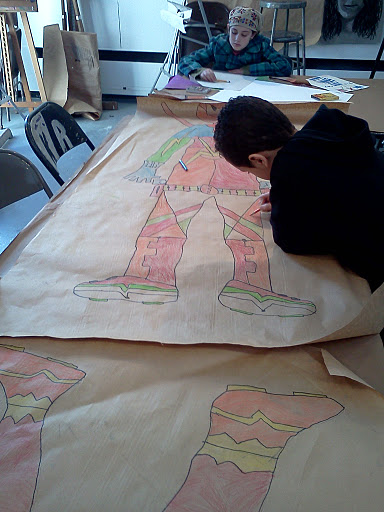
Lifesize andriods designed to save planet Earth!

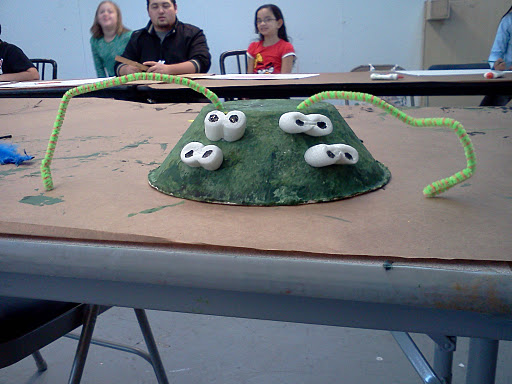
A paint bug: lesson with sponge painting and light, middle, & dark tones.

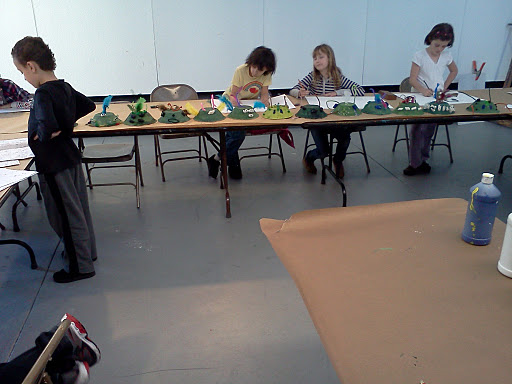
INFESTATION!

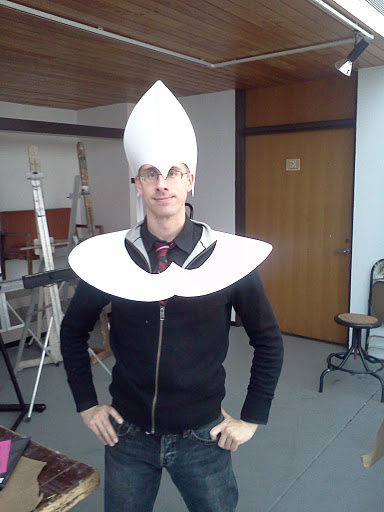
No, I’m not dressed as the pope. It’s the beginning of an alien disguise that will combine organic & geometric shapes.

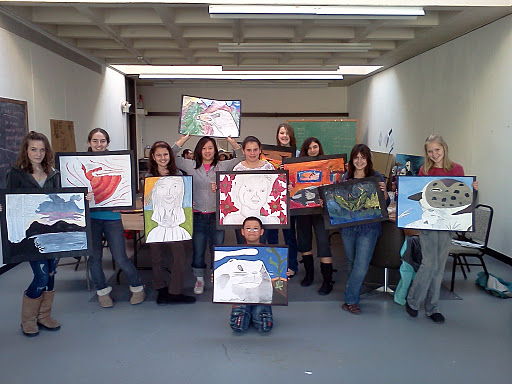
A group of very serious artists with their final pieces that incorporated both drawing and painting.

New painting

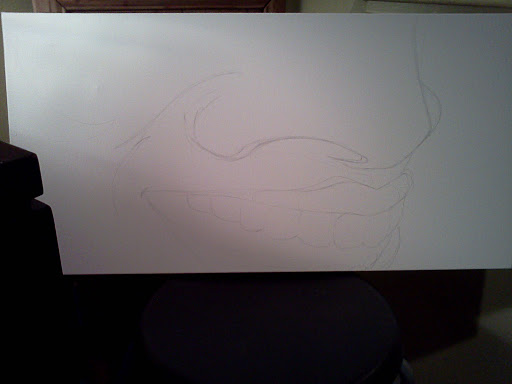
In between wrapping up current Drawing and Painting classes I’ve been trying to get my own painting in. I’ve been semi-successful. Pictured here is a new piece ready to be painted. Working title, “Pure Joy”.

Time flies!


There I was, preparing for eight days of fun and sun in Mexico when I got a call that I was needed for a long-term sub position at two elementary schools for a veteran art teacher. Oh, and the assignment would start as soon as I returned to the States! I drafted some beginning lesson plans on the flight back home and packed my teacher bag of tricks the night before. The reception I received at both schools was heartwarming and I couldn’t have asked for better coworkers and students to work with at the beginning of the school year (oh, did I mention that?). My first week was a simple introduction of me as an artist/teacher, why I love Art, and what students should expect from my forty-five minutes of class every week. As fun and engaging as I am, I’m tough, and expect only the best work. As a new educator with only three years of experience, mostly in private institutions, I learned two valuable lessons this past month and a half.

Lesson #1, Time Management

I’ve always been organized, but bustling from class to class, each with twenty of more students can be a (fun) challenge. It became more important than ever to get the point of the lesson, explain the directions of the project, highlight the day’s objective, pass out materials, and zip around the classroom assisting those who required aid or had lingering questions. As I got into the groove of the weekly schedule I knew what materials to have laid out or packed on the art cart. But more importantly, I learned how to filter through student enthusiasm or silliness to bring attention back to my main points so work could begin more quickly. A friend and mentor of mine, Kathy, has been closely observing my progress for the last year and visited me at various times during my assignment. Each time she came, she left me with suggestions as to how to better improve the efficiency of each class. Often times her suggestions were something I knew to do, but somehow neglected in class. It’s understandable I know, to forget something when one is pressed for time, but it’s particularly important to make sure students understand just why they’re making making fish, board games, or constructing self portraits that need to be mounted. I always try to segue from one lesson to the next, so that each is tied to one another and students can see the progression as their work builds, based on lessons they’ve learned in the past. When a student begins to put this link together in their head, they get excited at their progress and are eager to move further. At least, that’s my hope. Kathy stressed that I should reiterate the objective and explain how the project performed this at the end of each class. Reinforcing the lesson can only help the following week when I start a new project connected to the last. This is a great strategy that I know was introduced to me in college and it works well when I have the students explain everything back to me. In the end it also speeds up instruction for the next week class. It’s important to have a fresh pair of eyes and ears to give you a perspective other than your own when it comes to your work. I’m grateful to have this for both my teaching and painting.

Lesson #2, Working With Students With Severe Disabilities

I was unaware I would be working with students with mental and physical disabilities. But instead of shying away from the idea, I embraced it. Everyone, at any age, needs Art in their life, but especially children and these students are no different. I knew that the lessons I prepared for their intended age group would be past their level of comprehension or physical capabilities, so I chose to use lessons for a younger age set. I focused on simple shapes, using those to build works of art, and color exploration, starting with the primary colors. I quickly learned not to have preset expectations of the students, many of whom would have as many great days as they did bad days, more so compared to someone who would be judged an average student. And by bad days, I’m not talking about behavior necessarily, their frustrations or disparagement of an activity could stem from something outside of art class. I did try to get every student as involved as possible, working hand over hand with some, paying close attention to and encouraging any interaction a student made with the task at hand. I judged our success based on their reaction to the final products we produced. It was challenging  because with these groups there were greater scopes of learning/understanding between students. The students’ regular classroom teachers were a wonderful resource and I would often pop in throughout the week and throw ideas at them for future projects looking for input. It was always uplifting when I saw everyone’s face light up when I walked into the classroom — I knew I was doing something right, especially when students became more and more involved.

Most of this blog has been lifted from notes I made following a conversation with Kathy after she had spent a morning with me. I felt it was important for me to review and share these notes and see how I can use these lessons that I learned for future classes to better myself as an educator. More to follow in the future, I promise!